
Accessing Layton Public Records
The first issue is jurisdiction. Layton keeps its own permits, police reports, council records, business-license files, and municipal administration. Davis County keeps deeds, ownership plats, assessments, tax records, marriage licenses, and election records. Utah agencies hold statewide court indexes, current certificate systems, professional licenses, and correctional records. Access may mean a free index, a paid image, an office terminal, or a request to the office that created the file.
| Layton record group | Keeper | Web access | Public status or fallback |
|---|---|---|---|
| Deeds, mortgages, liens, plats | Davis County Recorder | Property Search and REDI-Web | Public index and property data; terminal, books, mail, or paid images |
| Assessment and tax | County Assessor and Treasurer | Property Search 2.0 | Free informational parcel detail; division counter for questions |
| District and justice cases | Utah Courts | Xchange | Paid web search or free courthouse terminal; closed case classes excluded |
| Birth, death, marriage, divorce | Utah Vital Records, local health department, Clerk, or court | Certificate order service | Recent certificates restricted; historical records open after set periods |
| Police and jail material | Layton Police or Davis County Sheriff | Current inmate roster | Roster is free; reports use a focused records request and may be redacted |
| City permits, code, meetings | Layton City | Meeting pages and Open Records Portal | Public portions available; no complete permit or code-case index located |
Public does not mean that every field or image is open. Utah withholds sealed and expunged cases, juvenile and adoption matters, many domestic filings, recent vital certificates, protected voter information, and motor-vehicle personal data. A custodian should release reasonably separable public portions when protected details can be removed.
Four Utah GRAMA Classes
The Utah Government Records Access and Management Act, known as GRAMA, classifies government material as public, private, controlled, or protected. Anyone may request a public record. Private records include specified personal data. Controlled records concern certain medical or psychiatric information, while protected records cover defined interests such as active investigations, security, procurement, and confidential business information. A request cannot turn a closed record into an open one.
The official Utah GRAMA research guidance explains how to identify an agency and use the state Open Records Portal.
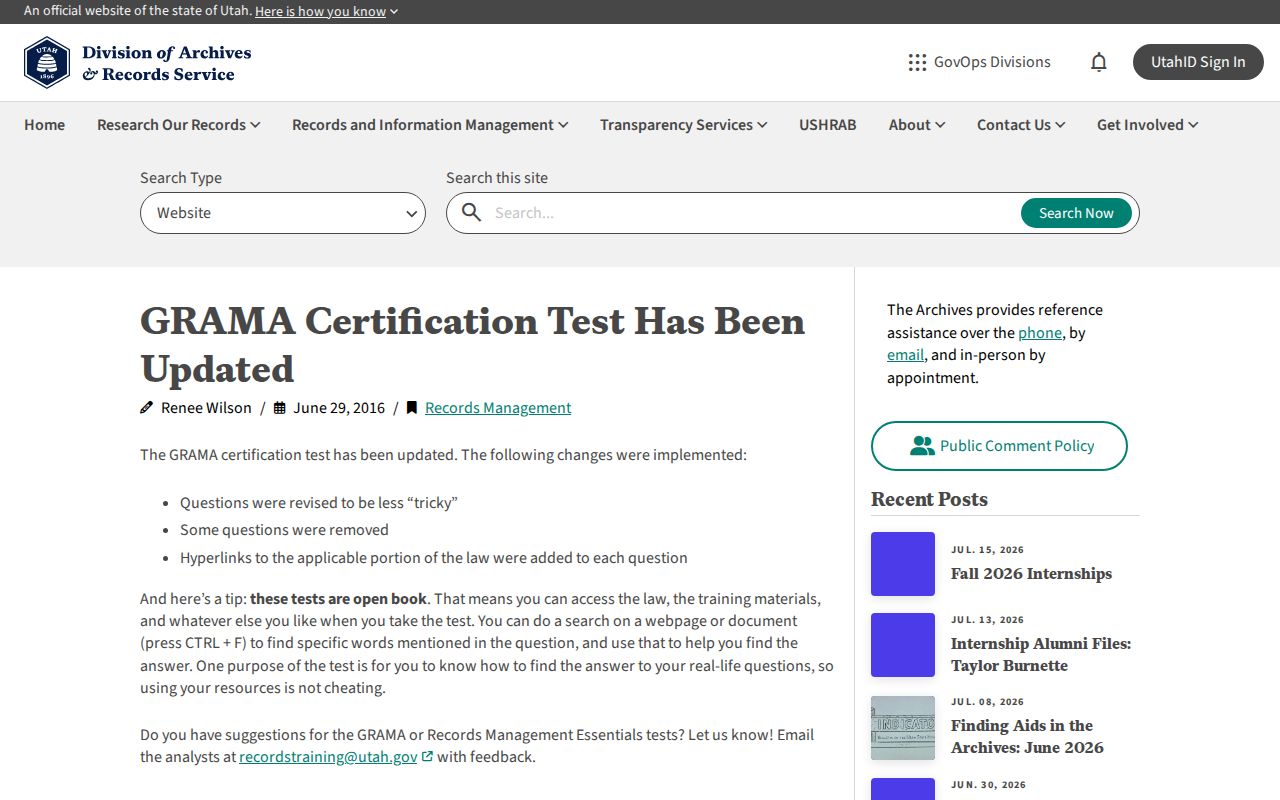
The guidance is useful when the needed Layton file belongs to a state or local entity but no direct database exists. GRAMA does not require an office to create a new report that it does not maintain.
Layton Recorder Records Since 1850
Davis County organized in 1850, and its Recorder traces office stewardship to that year. The office identifies historical land-record books beginning in 1870 and says computerization and microfilming began in 1981. No official source gives one exact starting year for every web index or document class. Older Layton land work may therefore require books or a public terminal rather than a broad online query.
The Davis County Recorder service page brings Property Search, REDI-Web, Property Watch, office access, and current copy services together.
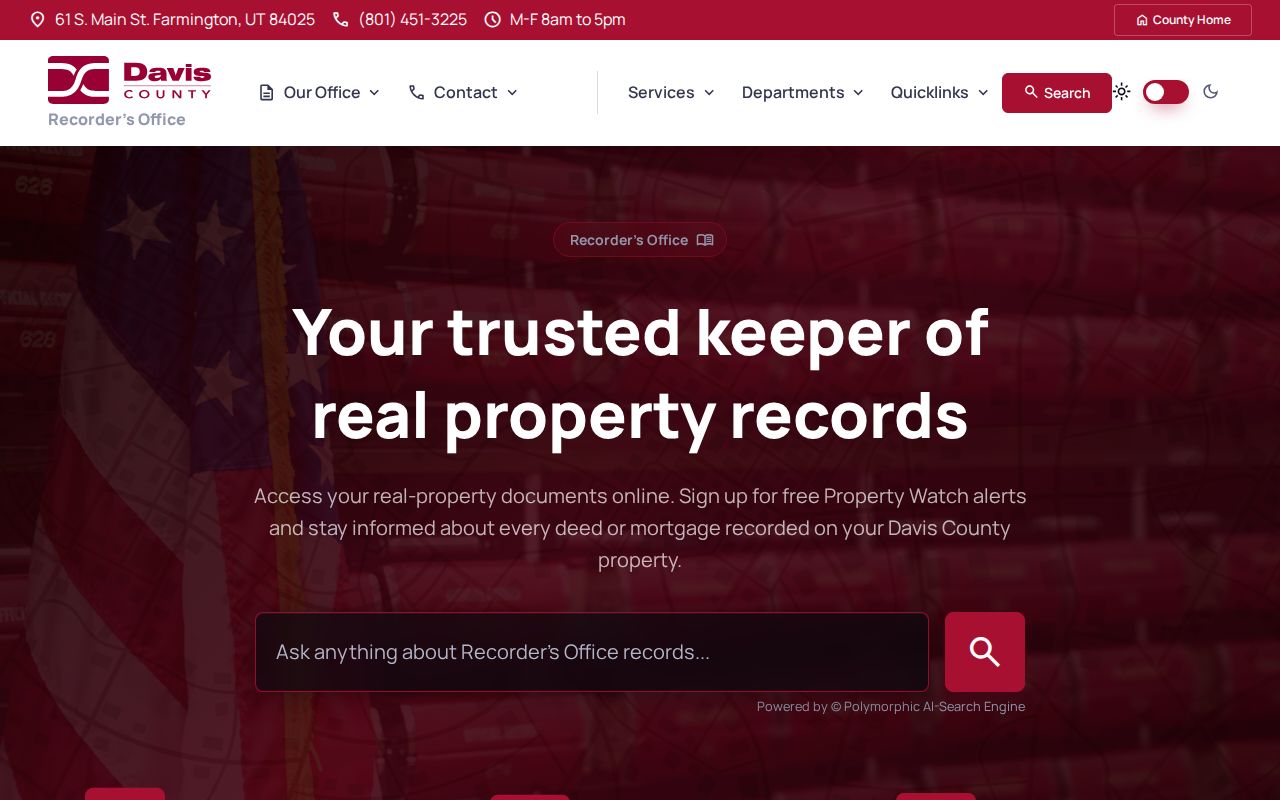
The Recorder helps locate parcels and records but does not perform a title search or give legal advice. Public terminals at 61 South Main Street in Farmington and mail requests remain important access channels.
- Index
- A list of recorded facts that points to an instrument; it is not always the document image.
- Certified copy
- A copy authenticated by the custodian for official use.
- Custodian
- The office responsible for keeping and responding for a record.
- Exemption
- A law or rule that permits or requires information to be withheld.
Note: Military discharge records receive special protection even though the Recorder keeps them alongside other recorded instruments.
Layton Property Search Routes
The free county map is strongest when an address or parcel serial is already known. It returns ownership, mailing address, situs address, legal description, acreage, boundaries, values, tax details, and links to recorded evidence. Situs means the land location, while a mailing address is where the tax notice goes. They may differ. The serial is the best join key across the map, assessment, tax notice, and recorder history.
| Field or action | Where used | Required | Purpose |
|---|---|---|---|
| Search | Free Property Search | Yes | Enter a street address or property-tax ID |
| Parcel or serial number | Free Property Search | Optional mode | Links the parcel across county systems |
| Document entry number | Recorder search route | Optional | Finds an associated recorded document |
| Owner name | REDI-Web | Optional | Runs the name search not advertised on the free map |
| Address, parcel, document number | REDI-Web | Optional | Offers alternate subscription search modes |
| View Parcel Detail | Free map result | No | Opens ownership, tax, traits, and legal description |
The Recorder property-search launcher describes the public land and ownership evidence available from the county.
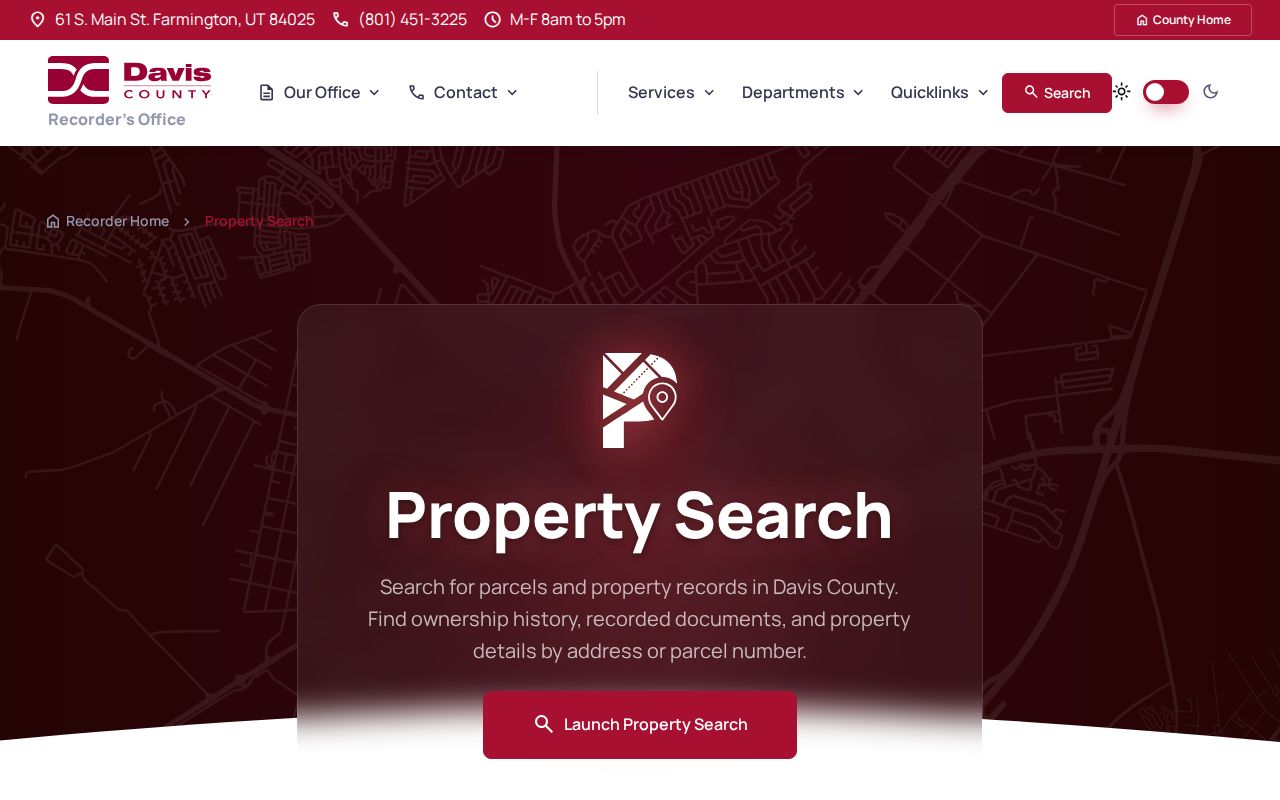
That launcher leads to the free Esri-powered map, where a selected parcel opens detail. It does not advertise an unrestricted owner-name box.
For broader land-record work, the REDI-Web service advertises searches by owner name, address, parcel, and document number.
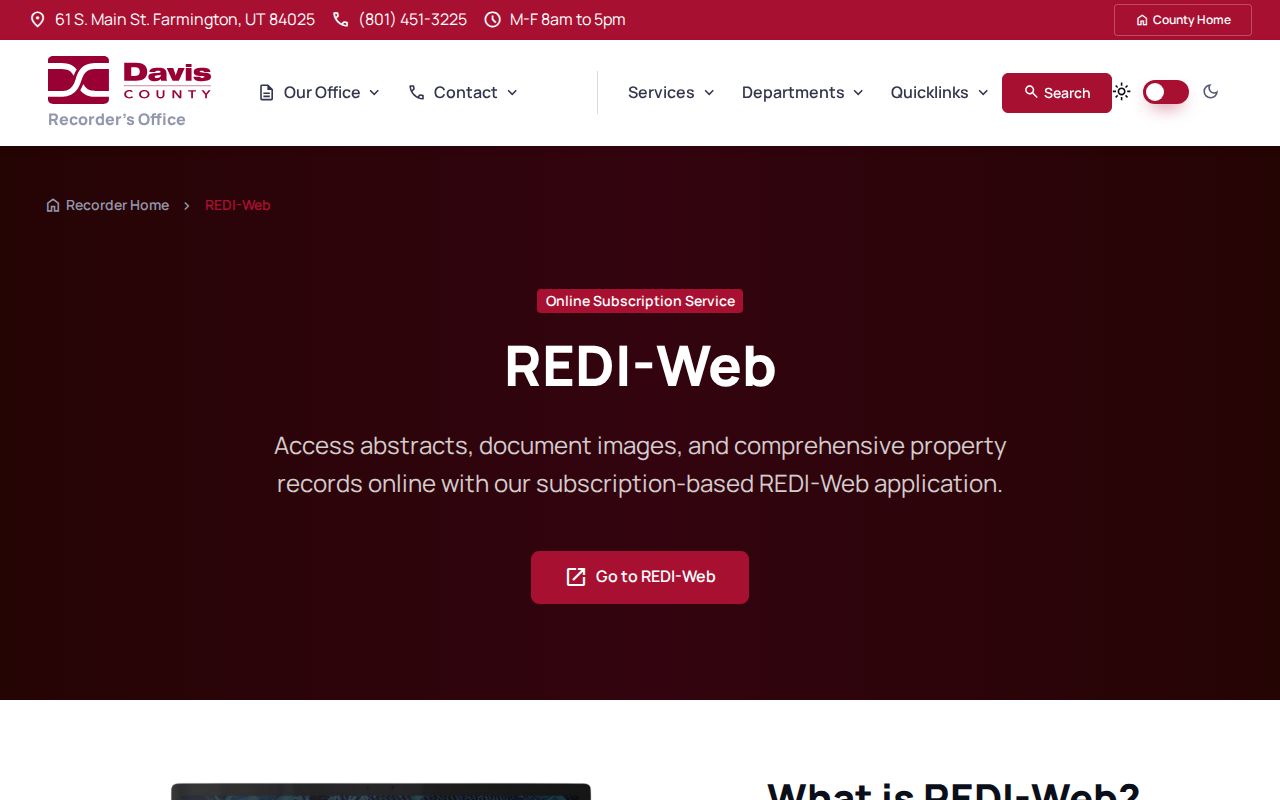
REDI-Web costs $25 per month and offers abstracts, plats, surveys, scanned images, and print or download functions. Counter terminals and recorder books are the offline alternative.
Note: Keep the parcel serial with every saved item because it connects county systems more reliably than street spelling or numbering.
Layton Court Records Boundaries
Utah Courts Xchange searches district and justice cases by party or company. Most district-court data are complete from late 1998, but justice-court start dates vary. Public district documents electronically filed since July 1, 2010 may be purchased when their classification permits. A result can show the court, case number, type, filing date, party role, events, charges, disposition, judge, public documents, and financial entries.
The official Xchange access page describes web subscriptions, coverage, and free public terminals.
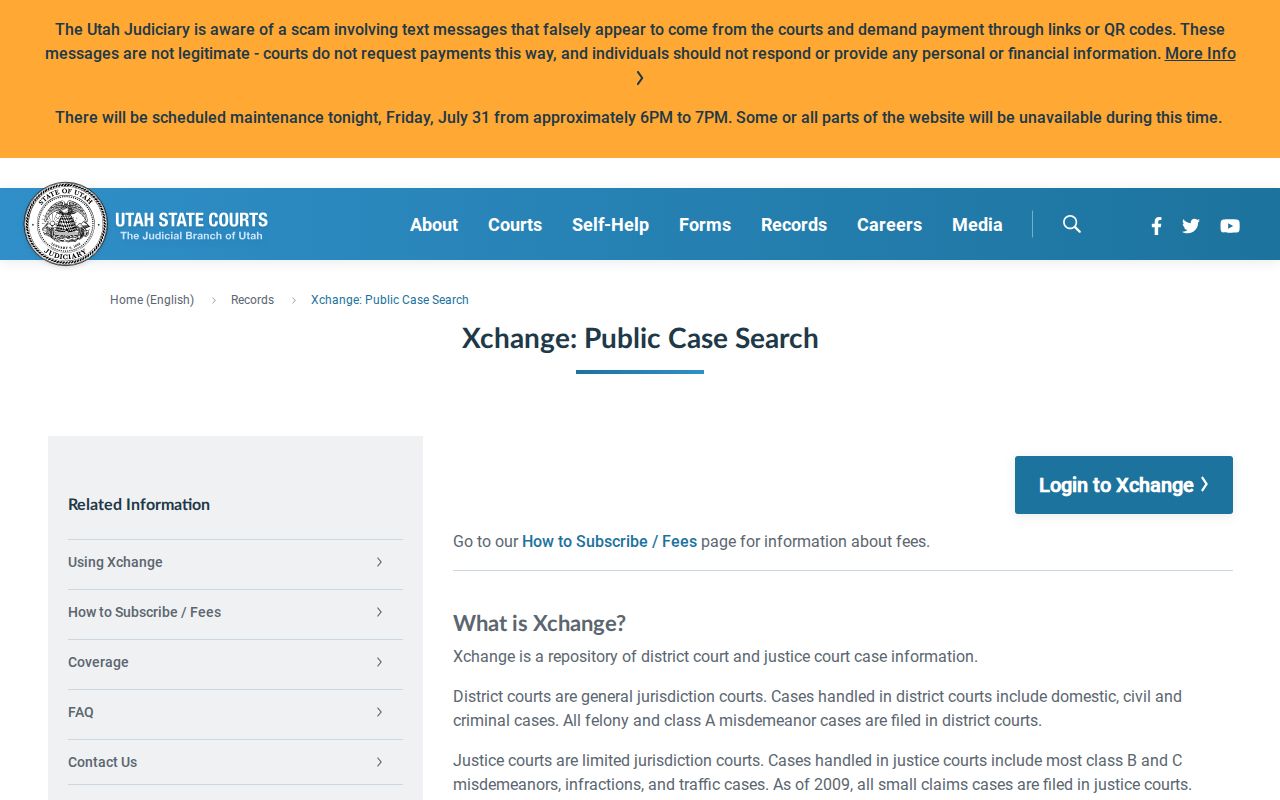
Online access is paid under the current Xchange account schedule, but most district courthouses and the Utah State Law Library provide free public access. A local clerk can supply eligible copies and older case help.
The Xchange field and results help documents how to narrow a party search.
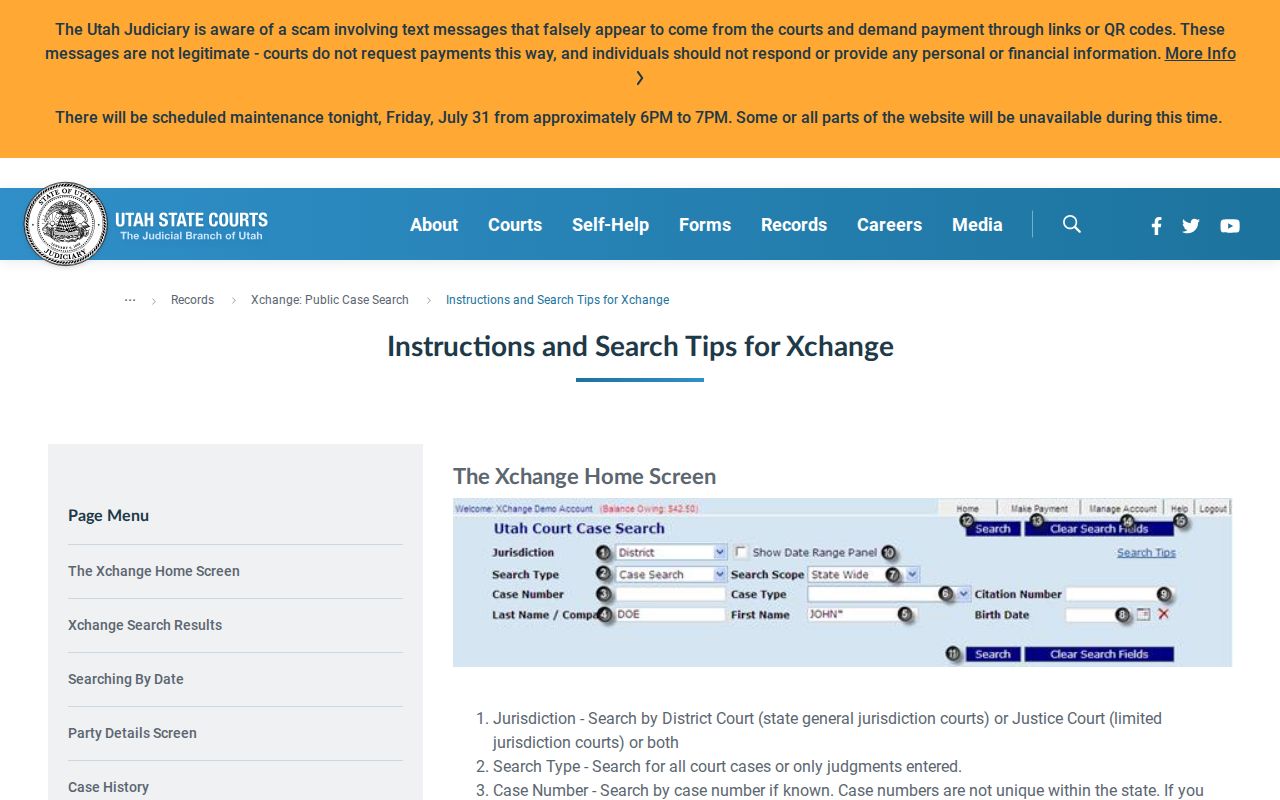
Useful fields include jurisdiction, case number, last name or company, first name, case type, county or court, birth date where available, citation number, and date ranges. An asterisk in the first-name field can find variants and middle-initial entries. Results stop at 500, so common names need more limits.
Public docket myth. An open case history does not make every filing public. Sealed, expunged, juvenile, adoption, and civil commitment cases are absent, and many domestic documents remain private.
Layton Vital Records Time Gates
Utah birth records become public after 100 years, death records after 50 years, and marriage or divorce records after 75 years. Recent copies require identity and a qualifying relationship or direct, tangible, legitimate interest under Utah Code §26B-8-125 and related rules. Layton is not a separate vital-record jurisdiction. Current service runs through Utah Vital Records or a local health department, while a Davis County marriage license and a court divorce file follow their own custodians.
The Utah certificate ordering page lays out online, local counter, and mail channels.
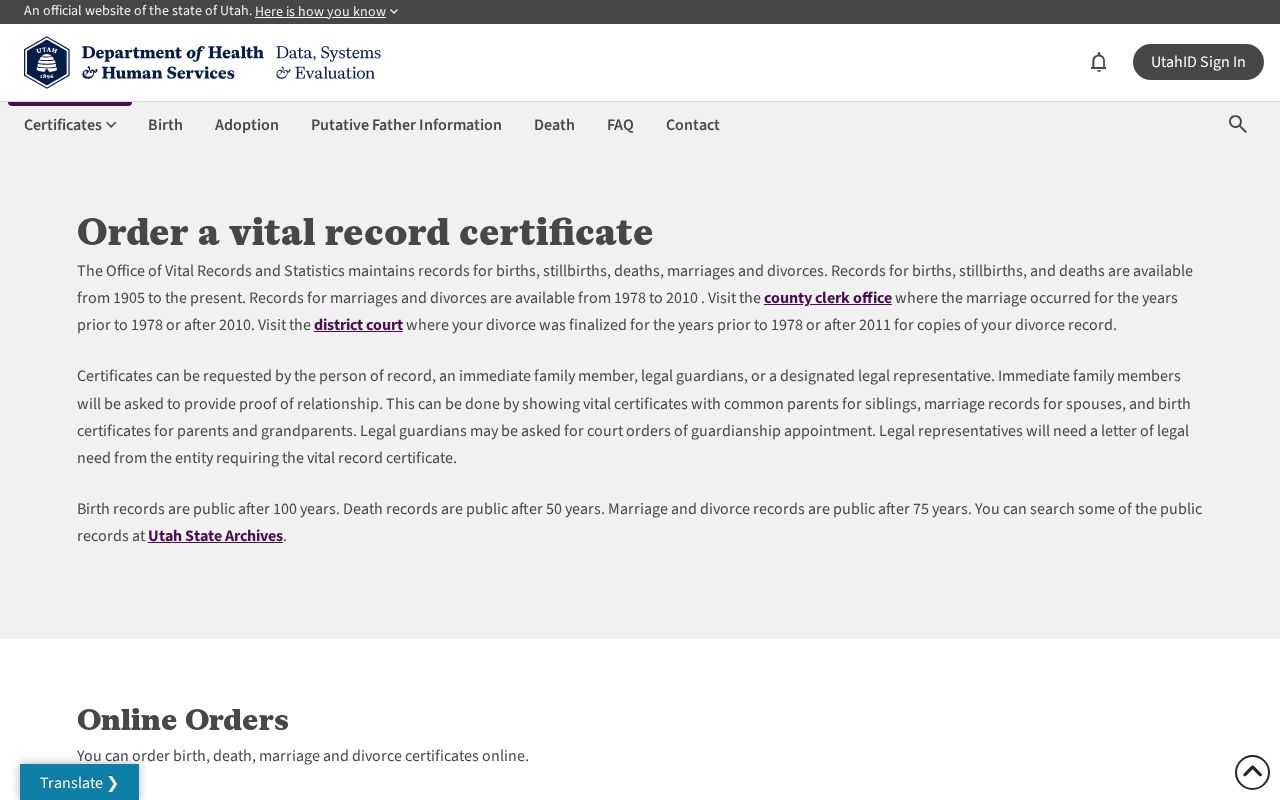
A mailed request needs a signed application or letter, the record details, relationship and reason, an item from Utah's accepted identification list, and the charge shown on the vital-record fee schedule. Utah advises allowing at least six weeks for ordinary mail processing. Once the age gate passes, the State Archives becomes the historical route.
Offices Behind Layton Public Records
Farmington is the county seat, so a Layton postal address does not place county files at Layton City Hall. The Davis County Administration Building is the shared counter for the Recorder, Clerk, Assessor, and Treasurer. These offices are open Monday through Friday, 8 a.m. to 5 p.m. Utah Courts and Vital Records operate separate statewide systems.
Utah Courts
Second District Court and Layton Justice Court
Local clerk or courthouse terminal
The correct counter depends on who made the file. The Recorder handles land instruments, the Clerk handles county elections and marriage licensing, and the Assessor handles value questions. Police reports go to the agency that created them.
Layton Custody Records and Scams
The Davis County inmate roster covers current county custody, not a full criminal history. It shows booking date, first and last name, gender, age, and a details link with charges and bail information. Release dates and times are withheld for safety. The Davis County Sheriff service hub supplies the agency contact and records-request route. State and federal custody use their own systems, and court disposition should be confirmed in Xchange.
A 2026 warning on the live roster describes callers who demand a large payment, often Bitcoin, for a supposed ankle-monitor release. The Sheriff says that program is court ordered, does not require direct payment from family, and does not accept Bitcoin. Call the published Sheriff number, 801-451-4100, rather than a number supplied by a caller. A roster entry or charge is not proof of conviction.
Note: Utah registry information may not be used to harass, stalk, threaten, or intimidate a listed person or family.
Layton Records Fees at a Glance
Fees depend on the product and access channel. Recorder document, abstract, legal-description, and ownership printouts cost $2 per page. A certified recorder copy is $5 plus $2 per page. The office advertises REDI-Web digital documents at $1 each, compared with $2 per page by mail or at the counter, and gives mail orders a five-to-ten-business-day turnaround.
| Record service | Published charge |
|---|---|
| REDI-Web subscription | $25 per month |
| Xchange guest access | $10 initial credit, $0.35 per search, $1 per available document |
| Birth, marriage, or divorce abstract, effective July 1, 2026 | $25 first copy |
| Death certificate, effective July 1, 2026 | $35 first copy |
| Additional copy of the same vital record | $10 |
A failed vital-record search still produces a certificate of search and does not erase the base fee. Under GRAMA, an office may charge actual duplication and reasonable staff costs. The first quarter-hour of staff time generally is not charged, and a requester may ask for an estimate, electronic delivery, inspection, or a qualifying fee waiver.
Three Layton Digital Records Thresholds
An empty portal result can reflect the age of the system rather than the absence of a record. Layton-related land, court, and city files began in different eras and moved online on different schedules. These dates guide the fallback, but none should be treated as a promise that every record from that year is available as an image.
- 1850 and 1870: The Recorder began in 1850 and identifies its historical book collection as starting in 1870.
- 1981: Recorder computerization and microfilming modernization began, but the office does not publish one exact web cutoff.
- Late 1998 and 2010: Most district courts had adopted CORIS by late 1998; public district e-documents filed since July 1, 2010 may appear in Xchange.
For pre-digital deeds, use Recorder books and terminals. For an older court matter, ask the clerk about indexes or archives. Layton incorporated in 1937, so earlier municipal history may be cataloged under Davis County, settlements, wards, or nearby communities.
Request Layton Public Records
A strong GRAMA request names an existing record and reaches the office that made it. Ordinary responses are due as soon as reasonably possible and no later than 10 business days. A qualifying request that benefits the public rather than one person may receive five-business-day treatment. Extraordinary circumstances permit more time with notice.
- Identify the custodian. Send a city permit or Layton police report to the city, a deed to the Recorder, and a court filing to the court.
- Check the existing index. Save a parcel serial, entry number, case number, incident number, license number, or event date.
- Describe the exact record, names, address, date span, division, identifier, desired electronic format, and whether inspection will work.
- Submit through the custodian form, email, mail route, or the Open Records Portal. Keep the confirmation and ask for a fee estimate.
- Review the response. Narrow an overbroad request, accept a redacted public copy when proper, or use the stated appeal route after a denial.
City police requests should include the incident number, date and time, location, parties, and the requested report, audio, or video. Active-investigation, victim, witness, juvenile, medical, personal, and security information may be withheld or redacted. The Davis Sheriff likewise directs report requests through GRAMA and states a response or denial may take up to 10 working days.
Lawful use. Open records support family, property, consumer-safety, and civic research. Utah law can punish stalking, electronic harassment, threats, or registry misuse.
Appeal a Layton Records Denial
A written denial should identify the withheld record, its classification or exemption, and the available appeal rights. Start with the agency chief administrative officer. Depending on the office and issue, further review may proceed to the Utah State Records Committee or district court. The Government Records Ombudsman can offer help and mediation.
Read the denial closely before appealing. A clearer date range or identifier may resolve a scope problem faster. When only part of a record is closed, ask whether the office can segregate and release the public portion. A GRAMA appeal does not override a court sealing order, vital-certificate eligibility rule, protected voter designation, or federal privacy limit.